Quality in a fragrance launch is not produced by an inspection at the end; it is produced by six or seven checkpoints placed where a defect can still be corrected cheaply. Brands that specify those checkpoints in the purchase order usually get a quieter first run, and they also get the documents that answer retailer questions months later. A first order is a test of the process, not only of the product.
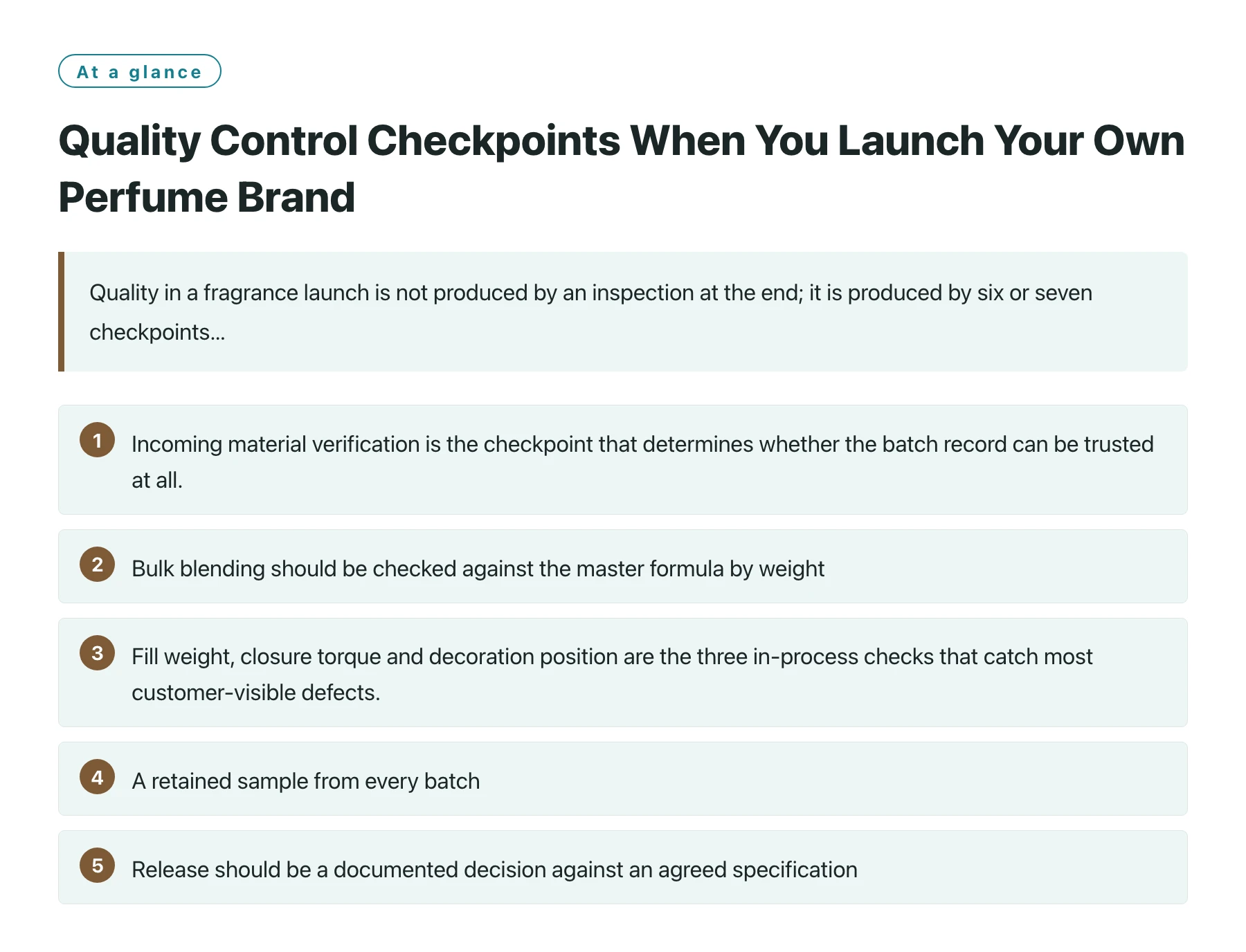
Key takeaways
- Incoming material verification is the checkpoint that determines whether the batch record can be trusted at all.
- Bulk blending should be checked against the master formula by weight, with the record signed at the time rather than reconstructed afterwards.
- Fill weight, closure torque and decoration position are the three in-process checks that catch most customer-visible defects.
- A retained sample from every batch, stored with its paperwork, is the cheapest quality tool available to a brand.
- Release should be a documented decision against an agreed specification, not an informal confirmation that the pallets are ready.
A brand launching its first perfume line usually has no quality team of its own. That is not a disadvantage if the checkpoints are named in advance and the supplier's records are structured to show them. It also helps to know what the finished project is supposed to look like: the sequence described in what it takes to launch a perfume brand puts quality checks in the same order as the production stages, which makes the plan easier to follow.
The sequence below follows the product through the factory. At each checkpoint, the question to ask is the same: what evidence exists that this step was done to specification, and who signed it.
Seven checkpoints through a first run
- 1. Incoming material verificationEach raw material is checked against its specification on arrival, with the batch reference recorded. Without this step, the batch record cannot prove what actually entered the product.
- 2. Weighing and compoundingMaterials are weighed against the master formula, with deviations noted rather than corrected silently. The signed weighing record is the core of traceability.
- 3. Bulk check before fillingThe blended and rested bulk is compared against the approved reference for odour and appearance. This is the last point at which a formula problem can be corrected without scrapping filled units.
- 4. Fill weight and closure integrityUnits are sampled during the run for fill volume within tolerance and for closure torque or crimp quality. Pump seepage in transit usually originates here.
- 5. Decoration and assembly positionLabel and print position are checked against the approved artwork during the run, so that a misaligned print run is stopped rather than finished.
- 6. Finished goods testingThe released batch is tested against the agreed specification, and the results are recorded in the certificate of analysis for that batch.
- 7. Retention sample and releaseA sealed sample from the batch is retained by both parties with its paperwork, and release is signed as a decision. The retention sample is what future complaints are compared against.
Why the early checkpoints matter more than the visible ones
Buyers naturally focus on what they can see: the filled bottle, the label, the carton. Those are genuine checkpoints, but a defect visible at filling usually has an origin earlier in the chain, and by the time it is visible the correction is expensive.
A cosmetics GMP framework such as ISO 22716 exists to distribute these checks through the process rather than concentrating them at the end, and a supplier working to it will treat the batch record as the normal output of production rather than as a document prepared for a customer [1]. If you are auditing a new supplier, reading one complete record from intake to release tells you more than any certificate on a wall.
The three questions that test a record
Can every material in the formula be traced to a specific incoming batch? Is there a signed weighing record with any deviation noted? Does the release decision name a person and a date? A record that answers all three is a working document; one that answers only the last is a formality.
Where restriction compliance sits
Restriction compliance is a formulation decision rather than a production checkpoint, and it should be confirmed before bulk blending begins. The use-level standards that the industry works to are published, and a responsible manufacturer can state where the approved formula sits against them [2]. Discovering a restriction problem after filling is the most expensive version of this mistake.
Writing the checkpoints into the order
A quality plan that exists only in conversation tends to be remembered differently by each side. The practical version is a short annex to the purchase order that lists the checkpoints, the acceptance criteria for each, and the records that will be handed over at the end. On a first order, a manufacturer used to fine fragrance manufacturing will usually have a standard annex you can adapt rather than a blank page.
That annex also makes the first order comparable to the second. When a reorder arrives, the same criteria can be applied, and any drift in fill weight or in scent profile shows up as a difference rather than as a feeling.
Set the acceptance criteria before the run
Acceptance criteria should be specific: fill volume within a stated tolerance, decoration position within a stated offset, scent matching the retained reference within a defined comparison method. "Good quality" is not a criterion, and it cannot be enforced.
Decide who checks what
Some checks belong to the manufacturer, some to the brand, and one or two are worth witnessing together on a first order. A factory that describes its work as what one-stop scent development covers can usually accommodate a joint check at bulk and at filling, which is where the brand's presence adds the most information.
Quality after the shipment
The job is not over when the pallets leave. Retailer complaints and market surveillance questions arrive weeks or months later, and the ability to answer them depends on what was kept. Cosmetic safety rules in destination markets, such as those published by Health Canada, are written around the assumption that a seller can produce that evidence on request [3].
Hold the retention sample and the batch file together, and note the storage conditions in your own warehouse. If a complaint does arrive, the sequence should be: compare the returned unit with the retention sample, check the batch record for that production date, and establish whether the difference is in the product or in its storage.
Watch for drift on the second order
Most quality problems in a young brand appear at the second or third order, not the first, because attention relaxes once the relationship feels established. Comparing each delivery against the retention sample and the batch certificate is a five-minute habit that catches drift early.
Keep the file, not just the certificate
A certificate on its own answers a narrow question. The full file — formula reference, batch record, test results, artwork proof, declaration content — is what supports a decision when a retailer asks something unexpected. Building that folder from the first order costs nothing and is difficult to reconstruct later.
A useful standard for a first run: if a defect would not be visible to a customer but would matter to a retailer, put a checkpoint on it anyway. Retailer audits look at records, and records are built at the checkpoints, not at the loading dock.
Sources
- SGS: Cosmetics, Personal Care & Household Testing —— Testing, inspection and certification services for cosmetics and personal care, including microbiological, stability and safety testing aligned with cosmetics GMP.
- IFRA Standards Library (International Fragrance Association) —— The IFRA Standards Library lists the restrictions the fragrance industry applies to individual fragrance ingredients, based on safety assessments; it is the reference point for compliant fragrance formulation.
- Health Canada: Cosmetic Safety —— Health Canada's cosmetics pages, covering cosmetic notification, the ingredient hotlist and safety requirements for cosmetics sold in Canada.
Frequently asked questions
Do I need a quality agreement with a fragrance manufacturer?
A formal agreement is not always required, but a written annex listing checkpoints, acceptance criteria and the records handed over at the end is worth having from the first order. It removes the ambiguity that disputes are usually made of.
What is a retention sample and how long should it be kept?
It is a sealed sample from a specific batch, kept by both the brand and the manufacturer. Keep it at least as long as the product's stated shelf life, together with the batch paperwork, so that later complaints can be compared against the actual production.
How do I check quality if I cannot visit the factory?
Ask for the batch record, the certificate of analysis and photographs or video of the in-process checks. Then verify the delivered goods against the retention sample and the declared fill volume on arrival.
What causes the most customer complaints in perfume?
Perceived longevity and leakage are the two most frequent issues. Longevity traces back to dosage and to how the scent behaves in the wearer's climate, while leakage usually traces back to the closure and to packing quality in transit.
Is a certificate the same as a quality guarantee?
No. A certificate shows that a system was audited or that a batch was tested; it does not guarantee a specific outcome for your order. The batch record and the retention sample are what let you verify what was actually produced.