Budgeting the Second Box: A Household Plan From 37 to 370 TH/s
The first miner taught the household how pooling works; the second tests whether the budget learned anything. A 37 TH/s starter keeps about $1.35 a day after the listed charge, while a 370 TH/s upgrade keeps near $13.50. This plan walks a family from the first figure to the second without straining the monthly books.
Key takeaways
- 37 TH/s produces near 1.66e-05 BTC daily, about $1.41 gross at $84,692 per BTC.
- After the listed 4% on the block-reward component, roughly $1.35 a day remains.
- A 370 TH/s machine scales the same math tenfold to $14.06 gross and $13.50 kept.
- Fund the upgrade from three months of measured surplus, never from credit.
What the first machine taught the family ledger
Three months with a small unit rewrites assumptions. The household now knows the sound of fans at night, the size of the power increment and the rhythm of hourly credits under PPS+, the default settlement that pays the block-reward share each hour against current difficulty. The 37 TH/s box contributing 1.66e-05 BTC a day will not retire anyone, but it turned mining from a story into a line item.
Open the power bills from those three months and average the increase. That number, not the machine's brochure wattage, is the true operating cost, because it includes the extra cooling, the always-on network gear and the laundry dried a little differently. Subtract it from the $1.35 average kept income. The remainder is the household's verified mining surplus, the only honest funding source for expansion.
Keep expectations anchored to network scale. Total throughput near 1,003 EH/s with difficulty at 132.76 T divides the daily 450 BTC among millions of machines, so small rigs earn pocket money while teaching discipline. Families that respect that scale make better second purchases than those chasing the first month's luck.
Pricing the jump to a serious unit
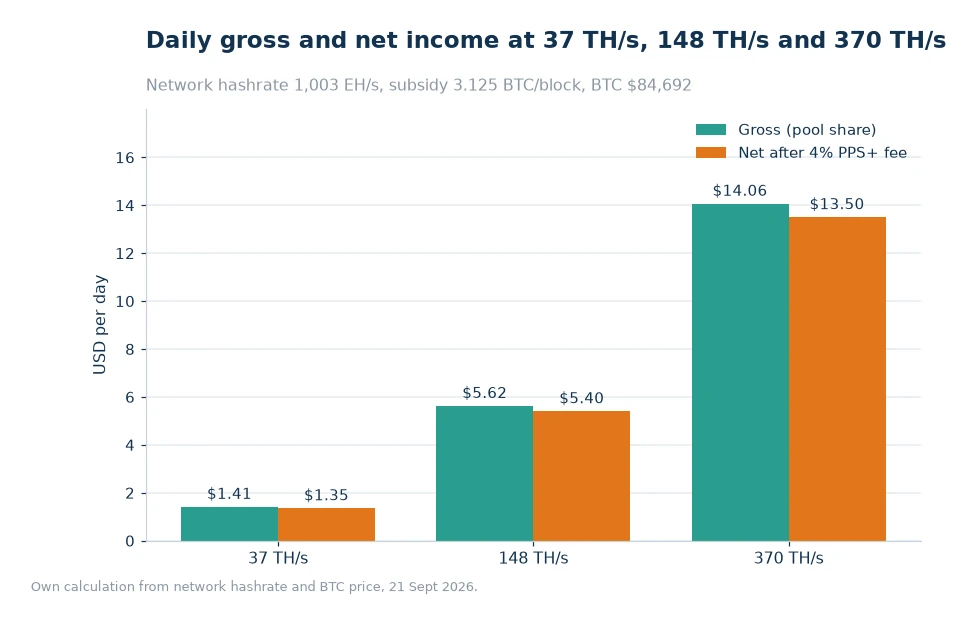
The chart's ladder frames the decision: 37 TH/s at $1.41 gross, 148 TH/s at $5.62 and 370 TH/s at $14.06, each keeping 96% after the listed 4% on the block-reward slice. The tenfold jump from the first rung to the third is the realistic upgrade path, since intermediate sizes often cost nearly as much to house and wire per terahash. Price the 370 TH/s class complete with delivery, cabling, ventilation and a repair reserve of at least ten percent.
Model the payback with the household's own power price. At $0.10 per kWh a modern 370 TH/s unit drawing near 3.4 kW costs about $8.16 daily in electricity against $13.50 kept, leaving $5.34 a day toward the purchase price. A $2,000 all-in cost then needs roughly a year, before difficulty moves. Enter the same figures in the ViaBTC Mining Calculator to confirm, since the Profit Calculator bakes in the listed PPS charge and current difficulty automatically.
Set a purchase trigger in writing: three consecutive months of positive surplus plus the repair reserve in hand. Written triggers protect against both fear and greed, the two emotions that buy machines at exactly the wrong moment. If the trigger has not fired, the answer is patience, and patience costs nothing to operate.
Fitting the new machine into a lived-in home
Heat and noise decide placement more than floor space does. A 370 TH/s unit exhausts like a hair dryer that never switches off, so a garage corner with ducted exhaust beats a spare bedroom in every season. Measure the circuit before anything else: a dedicated 20-amp line with no other loads is the minimum dignified arrangement, and an electrician's visit belongs in the budget, not as a surprise afterward.
Negotiate the domestic treaty early. Agree on quiet hours for maintenance, a temperature ceiling for the room and a rule that firmware updates wait for weekends. Mining rewards households that plan like roommates, because the machine cannot be reasoned with once it arrives. Uptime follows domestic peace more closely than most engineers admit.
Rehearse the failure drill together. If the dashboard shows the worker offline, the checklist is breaker, cable, then pool status, in that order. A shared note on the fridge with the worker name and the network stats view address turns a midnight panic into a two-minute routine that anyone in the house can run.
The household balance sheet at three sizes
Numbers settle domestic debates faster than opinions. The table lays the three rungs side by side in monthly terms at $84,692 per BTC, with a sample power line so the surplus is visible. Adjust the power row to the household's tariff and the decision practically makes itself.
| Monthly line | 37 TH/s | 148 TH/s | 370 TH/s |
|---|---|---|---|
| Kept income | $40.50 | $162.00 | $405.00 |
| Illustrative power | $24.48 | $73.44 | $244.80 |
| Surplus before repairs | $16.02 | $88.56 | $160.20 |
| Share of purchase pace | learning money | steady saver | pays its way |
Read the bottom row as temperament, not advice. The small rig teaches, the middle one saves and the large one carries its own weight where power is reasonable. Households should buy the temperament they can sustain through a difficulty increase, since the next adjustment, estimated near minus 2.12%, will move every column at once.
What the old machine is worth to someone else
Upgrades create a seller as well as a buyer. A working 37 TH/s unit holds modest resale value precisely because beginners like its price, and a documented hour of bench results with screenshots lifts the asking price above mystery boxes. List the measured effective hashrate, the error rate and the reason for selling in one honest paragraph; buyers reward candor with quick decisions.
Alternatively, redeploy rather than sell. A small unit heats a workshop corner through winter, teaches visiting relatives how pooling works and serves as a hot spare worker that keeps the account active during the big machine's maintenance downtime. At $1.35 kept a day it will not fund holidays, but as infrastructure it earns its shelf space quietly.
Worked example
Verify the starter rung from first principles. Daily BTC per TH/s is 450 divided by 1,003,000,000, or 0.00000044865. Times 37 gives 1.66e-05 BTC a day, the chart figure. Times $84,692 gives $1.41 gross. The listed 4% on the block-reward component leaves 96%: $1.41 times 0.96 equals $1.35 net. The upgrade rung follows identically: 370 times 0.00000044865 gives 0.00016598 BTC daily, times 84,692 equals $14.06 gross, times 0.96 equals $13.50 net. The middle rung cross-checks too: 148 times 0.00000044865 is 6.64e-05 BTC, worth $5.62 gross and $5.40 net.
Frequently asked questions
Should we sell the small miner when upgrading?
Usually keep it running while power allows. The 37 TH/s unit still contributes about $40.50 monthly kept income, and its worker history makes a useful baseline for spotting trouble in the new machine.
How much repair reserve is enough?
At least ten percent of the purchase price in cash. A single dead power supply can idle a $13.50-a-day machine for weeks if ordering parts requires a fresh decision each time.
Does the calculator reflect our tariff?
The Profit Calculator estimates coin income at current difficulty with the listed charge; enter your own kilowatt-hour price beside its output to reach the household surplus the table above illustrates.
Sign the trigger, then buy once and buy calm
Write the surplus rule on paper, track three honest months and purchase the 370 TH/s class only when the reserve and the trigger agree. Wire the dedicated circuit, duct the exhaust and tape the midnight checklist inside the cupboard door. Second machines bought this way hum along without drama, and drama is the most expensive accessory in home mining.
Sources: ViaBTC calculator and fee pages for estimation method and the listed 4%; statistics page for network figures. Chain inputs read 21 Sept 2026: about 1,003 EH/s, difficulty 132.76 T, 3.125 BTC subsidy, 144 blocks a day, BTC $84,692. Published 11 Nov 2026; figures assume continuous uptime[1].